Under the Paris Agreement, countries set out their climate commitments through Nationally Determined Contributions (NDCs). Kenya’s updated NDC puts implementation needs above USD 62 billion for 2020–2030, with 71% directed to adaptation and resilience, and the National Adaptation Plan (NAP) costs its actions at USD 38.26 billion through 2030. Both identify water scarcity, ecosystem degradation and drought vulnerability as priority risks.
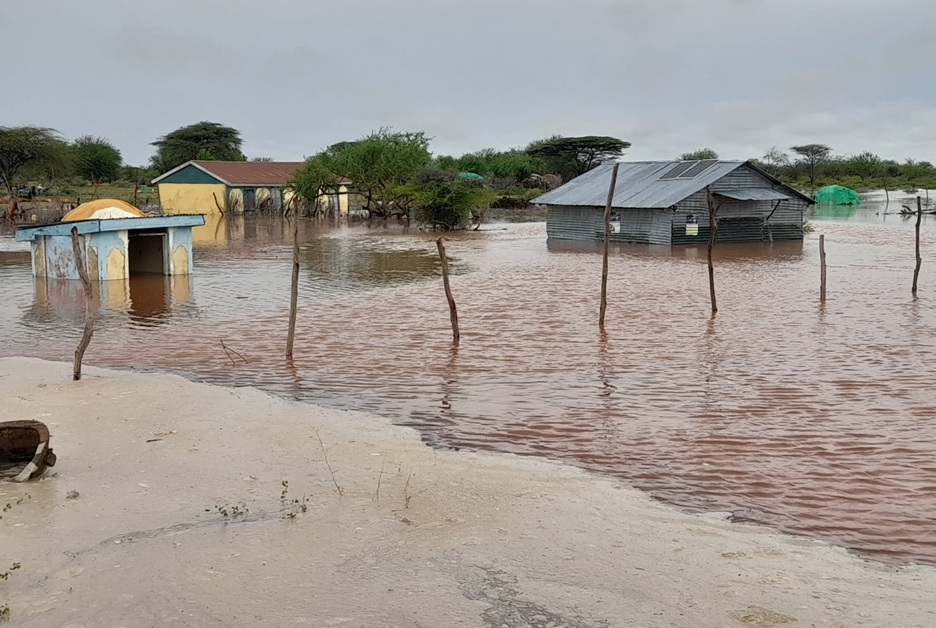
These commitments are not simply environmental ambitions; they are also economic and fiscal priorities. The case for financing these commitments rests on what climate shocks cost the economy. The Budget Policy Statement (BPS) 2026 records 64 flood events between 1964 and 2025, 2,647 deaths and USD 710.5 million in damage. It simulates flood damage equal to 2% of public capital stock in 2027, with revenue losses and debt pressures as a result. BPS 2025 estimates that destroying 2% of physical capital would cut GDP by about 0.8% without reconstruction, and BPS 2024’s hot scenario puts GDP about 4.2 percentage points below baseline by century-end.
Kenya’s policies and fiscal documents clearly recognise the risk. But is the budget financing the response? IPF’s Annual National Shadow Budget (ANSB) 2027/28 analysis of the Environment Protection, Water and Natural Resources (EPWNR) sector, which holds the irrigation, water storage, catchment protection and flood-control functions, suggests a clear answer: Kenya’s budget does not show the link between recognising the risk and financing the response.
In this blog as part of our ANSB 2027/28 series, we make two arguments. First, EPWNR’s budget priority is declining despite growing climate risk. Second, its prioritisation and proposals do not explain how climate considerations translate into allocations. We also find that the challenge extends beyond spending capacity to include implementation constraints. One caveat: our analysis covers EPWNR and does not trace climate-relevant spending in other sectors.
EPWNR’s budget priority is falling even as the risk is recognised. The sector’s final budget ceiling fell from KSh 128.0 billion in FY 2024/25 to KSh 106.7 billion in FY 2026/27, which is 16.6% lower, while the total of all sector ceilings grew by 13.8%. Its share dropped from 5.1% to 3.7%. Put simply, of every KSh 100 shared across sectors, EPWNR’s portion fell from about KSh 5.10 to about KSh 3.70. It is the only sector whose FY 2026/27 ceiling remains below its FY 2024/25 level.
The path was uneven. In FY 2025/26 alone, the ceiling was cut by 21.8%, from a provisional KSh 132.8 billion to KSh 103.8 billion. The pattern continues into FY 2027/28: the provisional ceiling rises 9.1%, but total sector ceilings rise 11.9%, so the share slips from 4.15% to 4.04%. Although other sectors may finance climate-relevant interventions, their increases cannot automatically count as replacement financing for EPWNR unless identifiable through specific interventions and outputs. The documents do not demonstrate this link.
The sector’s rankings and proposals do not show how climate priorities become financing. Climate considerations carry 15% of the programme ranking scores in EPWNR’s FY 2027/28 submission, yet the submission does not show how those rankings shaped allocations. The sector proposes KSh 134.4 billion against requirements of KSh 271.0 billion, which covers 49.6% of its stated needs. Also, 57.5% of proposed development financing comes from external partners, so delivery depends on when they disburse.
For example, irrigation shows the gap clearly. It ranks 100% in the sector’s prioritisation, but the Irrigation Development and Rehabilitation programme’s proposed allocation falls by 1.1% to KSh 9.6 billion, covering only 27.9% of its KSh 34.3 billion requirement. Irrigation development provision declined from KSh 18.3 billion to KSh 10.9 billion between FY 2024/25 and FY 2025/26, while water and sanitation rose from KSh 26.6 billion to KSh 51.8 billion. In a country where drought threatens food production, the budget should say what each allocation will deliver and what will be deferred.
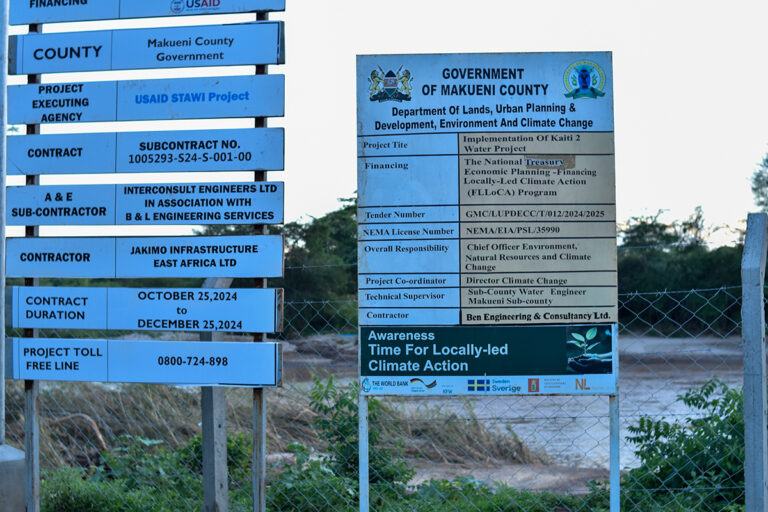
The gap is one of explanation, not spending capacity. Between FY 2024/25 and FY 2025/26, actual expenditure rose by 32.3%, from KSh 80.2 billion to KSh 106.1 billion, with absorption above 90% in both years. Selected water-storage and flood-control works met or exceeded their targets; in FY 2025/26, 0.97 km of dykes were built against a 0.30 km target.
Money alone, however, is not enough. Resettlement challenges and litigation affected the Athi programme, which achieved only 39.8% of its water-access target in FY 2025/26. Financing gaps and implementation constraints are distinct problems, each requiring a different set of solutions. While additional financing may be necessary to address resource gaps, it will not automatically resolve land acquisition, resettlement, litigation or other delivery bottlenecks. Budget decisions must therefore consider both the adequacy of allocations and the conditions required to translate those allocations into results.
Addressing this requires action from EPWNR, the National Treasury and Parliament. National Treasury Circular No. 10/2026 already requires climate considerations, documented prioritisation, performance reviews, measurable results and justified costing for the FY 2027/28 budget. EPWNR should submit a risk-to-financing schedule linking each prioritised intervention to its ranking, justified annual cost, allocation and expected output, and name what is unfunded or deferred.
The National Treasury should explain in the final BPS 2027 how climate risk and rankings shaped the sector’s ceiling. It should add resources where justified costs show the ceiling cannot deliver priorities, separating recurrent costs that sustain resilient infrastructure from spending with no clear climate link. Where money still falls short, it should say which outputs will be delayed. Parliament, through the Budget and Appropriations Committee and the relevant departmental committees, should require these explanations when considering the final BPS 2027. It should examine reductions affecting prioritised programmes, outputs forgone and risks left unaddressed and also scrutinise whether the proposed allocations are supported by credible implementation plans and whether delivery constraints are being addressed.
This blog has been authored by John Kiplagat, Research Assistant at the Institute of Public Finance