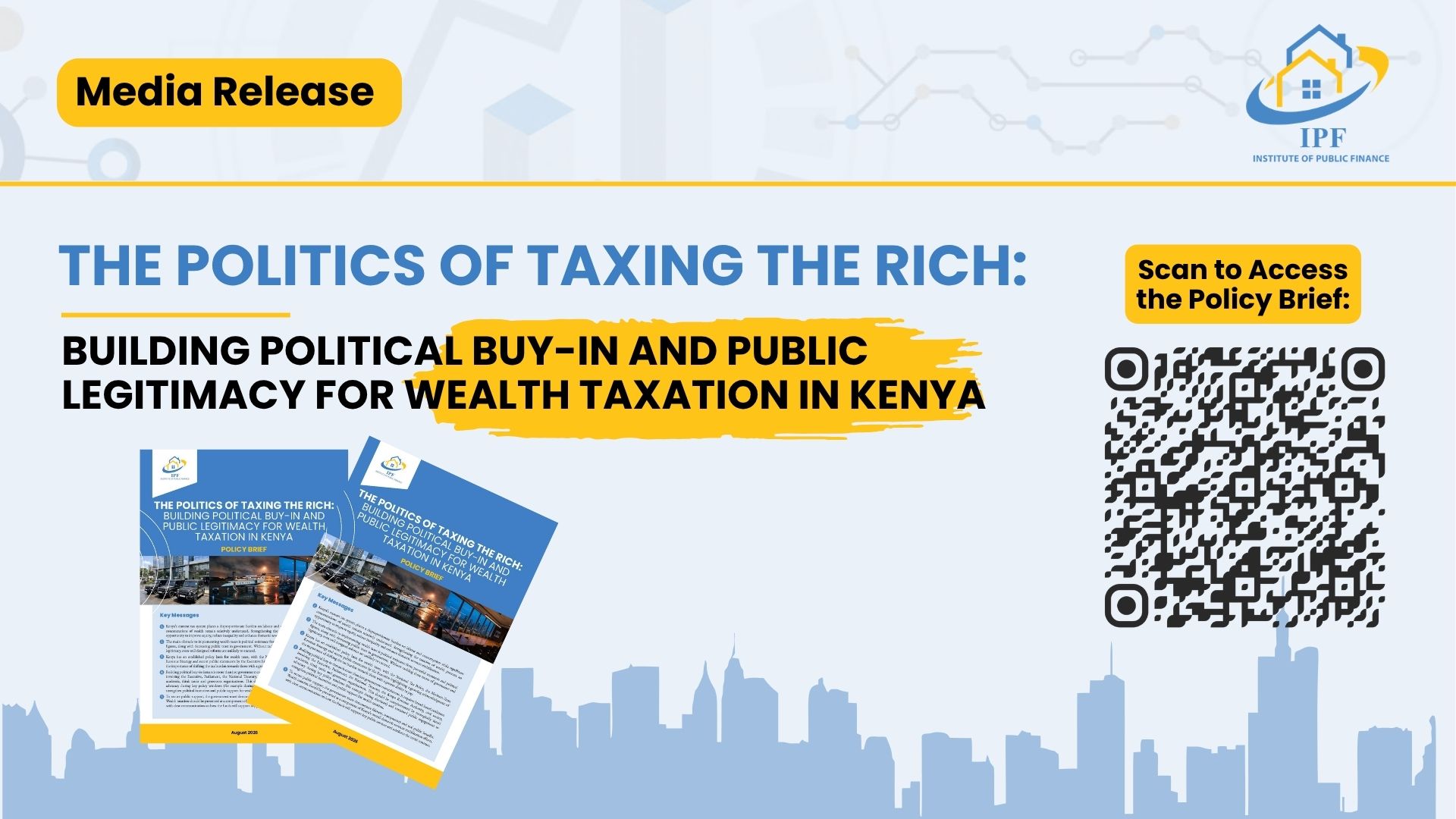
The Institute of Public Finance (IPF) takes note of recent media coverage across digital media platforms. This follows the launch of our policy brief: The Politics of Taxing the Rich: Building Political Buy-In and Public Legitimacy for Wealth Taxation in Kenya, where the media were invited as strategic stakeholders. We welcome the media interest in this important national conversation on Kenya’s widening inequality gap, public services being inaccessible for many citizens, and growing public debt concerns whose servicing crowds out public development and social spending.
IPF policy solutions for Kenya aimed at strengthening domestic revenue mobilisation and addressing structural inequalities in our tax system. As a reputable policy think-tank institution, our work generates credible evidence which informs our position on policy conversations. We therefore wish to state that the recent coverage by a section of the media has presented the IPF position too narrowly by characterizing the policy brief as a call for the return of the motor vehicle tax. This is not our factual position.
The policy brief is broader in scope in that it examines the political, institutional and public-legitimacy conditions necessary for wealth taxation in Kenya. It borrows from our Tax the Rich paper which calls for strengthening existing forms of wealth taxation, including the Capital Gains Tax, Rental Income and Property Taxes. In addition, the paper advocates for the introduction of a wealth tax on NET ASSETS (NOT MOTOR VEHICLES) targeted at HIGH-NET-WORTH INDIVIDUALS, particularly the approximately 6,800 US-dollar millionaires with net assets above the identified threshold of KSH 129 MILLION. The proposed approach is therefore focused on ensuring that individuals with significant concentrations of wealth contribute fairly to domestic revenue mobilisation. Any future wealth-tax measure must clearly establish what constitutes taxable wealth, who should be liable, how liability should be calculated and collected and whether the proposed tax base is an appropriate and reliable measure of wealth.
The brief further emphasizes the need for stronger wealth disclosure, institutional capacity, transparency, public trust and international cooperation to make wealth taxation effective and legitimate. IPF’s position is that wealth taxation merits serious consideration as part of Kenya’s broader domestic revenue mobilization and tax-equity agenda, based on evidence and careful policy design. We identify the under-taxation of significant concentrations of wealth as an important issue and argue that strengthening the taxation of wealth could improve equity and generate additional domestic revenue, while recognizing the collective role of stakeholders and the need to strengthen relevant administrative institutions. We therefore remain open to engaging with the media and other stakeholders to clarify the findings of the policy brief, correct any factual misunderstandings and contribute constructively to an informed national conversation on wealth taxation in Kenya.
For any further information, please contact: communications@ipfglobal.or.ke
Download IPF Media Clarification released on 24th September 2026.