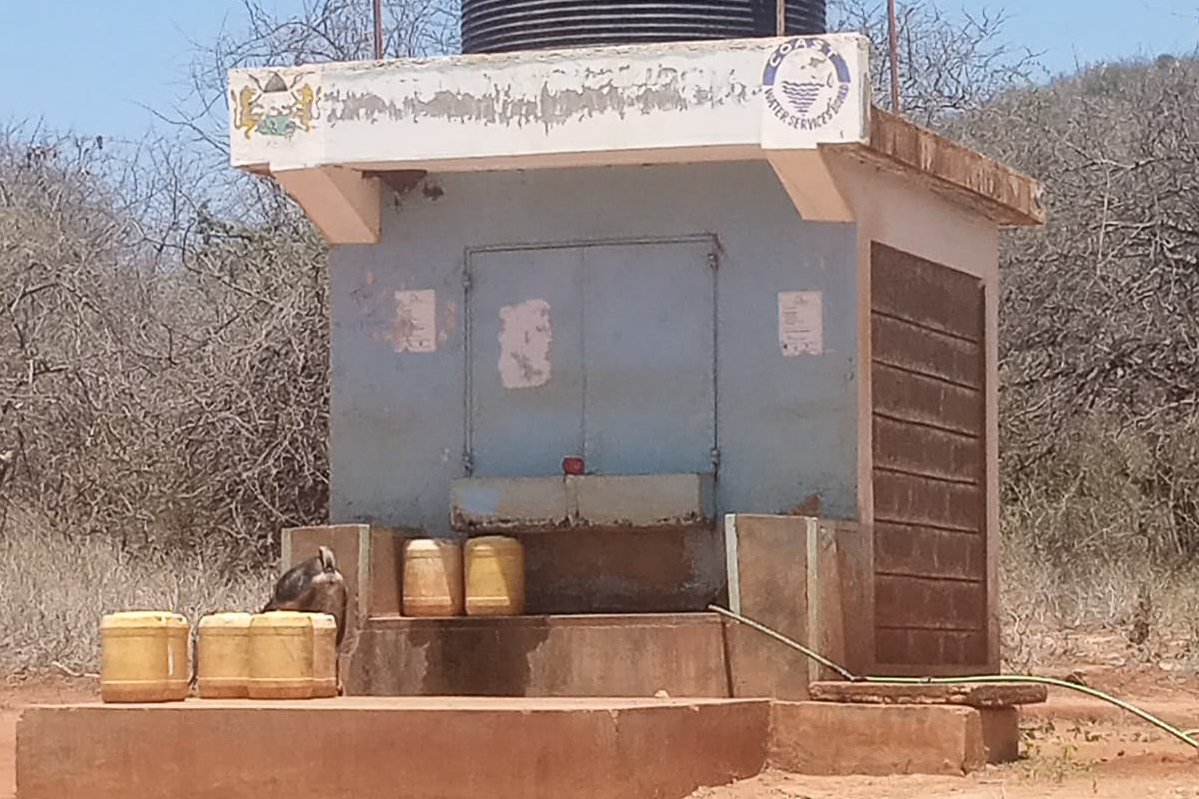
Every morning in Ngolia village, Taita Taveta County, women still walk miles to fetch water. Full of hope, they pass by the silent skeleton of a community water project that was supposed to ease their burden and bring clean piped water to their homes. The uncompleted community water project tells a story of a community’s struggle for accountability. Despite the county government allocating funds in the county budget for this project, the slow progress increases villagers’ calls for accountability.
The Ngolia–Mbololo Water Project, launched in the financial year (FY) 2019/2020, was intended to strengthen drought resilience and supplement existing water sources such as wells, springs, rivers, and boreholes. While some infrastructure has been put in place, residents report that the project has not consistently delivered the expected water services. In addition, many community members say they lack clear information about the project budget, allocations, and implementation.
Experiences like this illustrate a common challenge across development projects by the national or sub-national governments in Kenya. Projects may appear complete in official records, yet communities struggle to provide a linkage between expenditure of public funds and the intended outcomes they hoped would be achieved. In sectors such as water, where the impact of investments is felt immediately in people’s daily lives, this gap between public spending, information, and service delivery raises important questions about accountability. Without access to this information, residents struggle to hold implementers accountable or to identify what needs to be fixed when projects do not perform as intended.
Kenya has made notable progress in strengthening public finance management. County budgets are published, audits are conducted, and oversight institutions produce regular reports. However, experiences such as the Ngolia–Mbololo project show that gaps persist between planning, funding, and actual service delivery. These gaps are most visible where citizens experience public services directly when water does not flow, clinics lack medicines, or roads remain unfinished.
Social audits help to fill these gaps. Unlike formal audits and legislative reviews, which often take place long after funds have been spent, social audits operate closer to communities and in near real time. They allow citizens to ask practical questions: Was the project implemented as planned? Is it functional? Does it respond to community needs? These questions are critical for turning budget commitments into real outcomes.
While social audits are not new, technology is changing how effective they can be. Digital tools are transforming social audits from informal, paper-based exercises into structured and evidence-driven accountability processes. Recently in Taita Taveta, community members reviewing water projects used the Sauti ya Bajeti, a digital social accountability AI-powered tool developed by the Institute of Public Finance. The tool enabled them to capture geo-tagged photos, record citizen feedback, and link field observations directly to budgeted projects. This strengthens citizen voices and equips them with credible evidence making it easier to compare official plans with realities on the ground.
The Sauti ya Bajeti platform lowers barriers to participation. For many citizens, budget documents are often technical and difficult to understand. By simplifying budget information, Sauti ya Bajeti enables community members, many without formal training in public finance, to engage more confidently in oversight and public governance processes.
The impact of this approach goes beyond data collection. Technology helps bridge the gap between citizens and decision makers. When evidence is well documented and clearly linked to budget commitments, it becomes harder to ignore. In Taita Taveta, the digital platform has enabled social auditors to upload findings in real time, allowing evidence from the field to be quickly compiled and analysed. This reduces the time between data collection and engagement with county officials, making it easier to raise issues and decision making during the project implementation period.
The lesson from Taita Taveta is clear: accountability is not only about laws and reports. It is about connecting public systems to communities and their lived experiences. Social audits today should embrace digital tools which would make them more timely, credible, and impactful to ensure that public investments deliver services where they matter most.
This blog has been authored by Felix Masikonte, MEL and Project Officer at the Institute of Public Finance